Aesthetic Dentistry · Veneers
No-Prep vs. Minimal-Prep Veneers:
What "Korean Veneers" Actually Means
What this guide covers
"Are Korean veneers really done without any filing?"
"How do I know if no-prep will look natural on me?"
Short answer: "Korean veneers" describes a look, not a single clinical protocol. It can mean traditional preparation, minimal-prep, or true no-prep — and which one is appropriate depends on your tooth size, not a marketing label. Getting this wrong is the most common reason no-prep veneers end up looking bulky instead of natural.
"Korean Veneers" Is Not One Technique
Much of what's published in English under "Korean veneers" treats it as a single, defined style — thin, white, uniformly "natural-looking." Clinically, the more useful distinction is how much enamel is removed before the veneer is bonded:
- Traditional preparation — a defined layer of enamel is removed to make room for the veneer
- Minimal-prep — a small, controlled amount of enamel is removed, mainly to avoid excess bulk
- No-prep — no enamel is removed at all; the veneer is bonded directly onto the existing tooth surface
None of these is inherently "the Korean way." Which one is right depends on a single, measurable factor: how the current size of your teeth compares to the ideal.
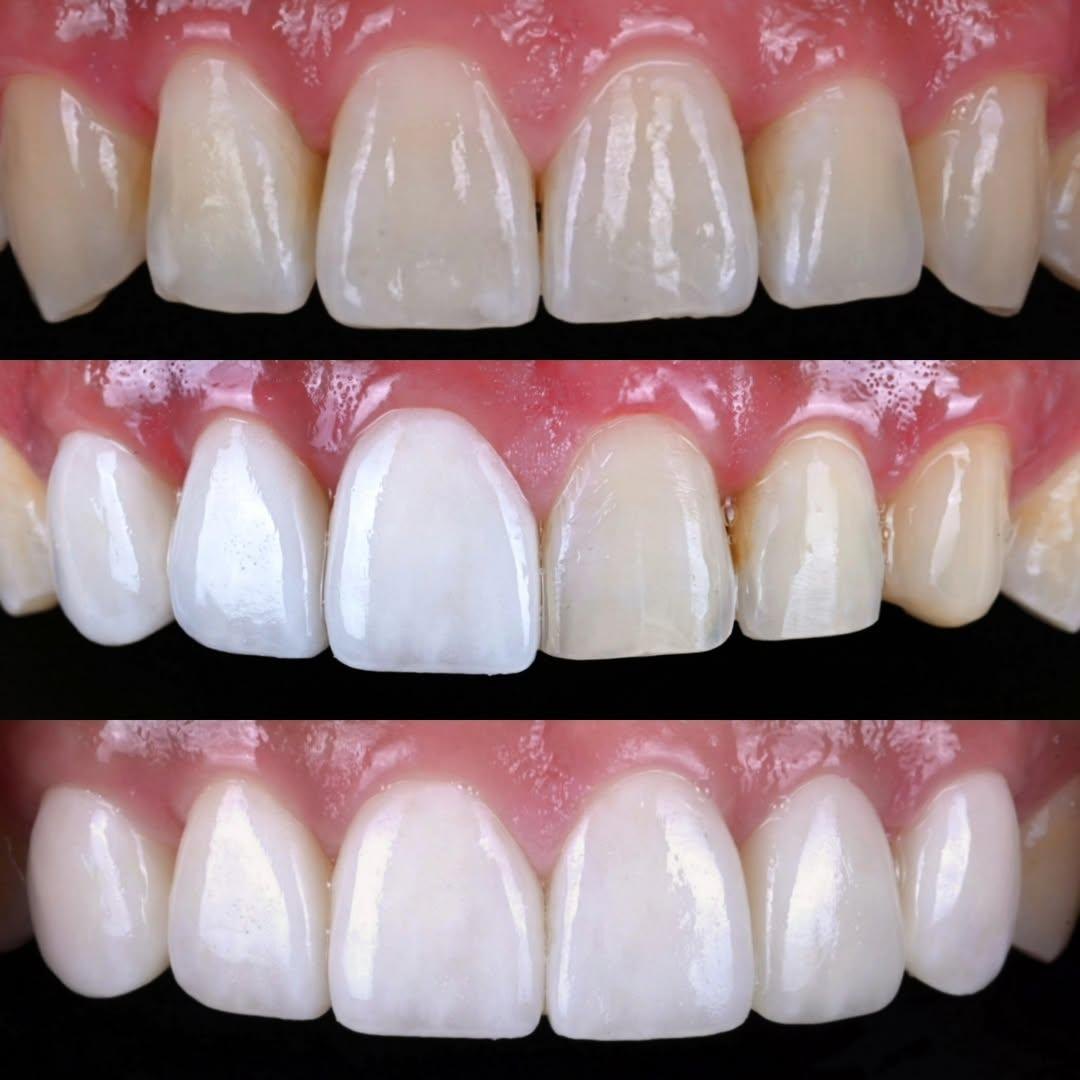
Why No-Prep Makes the Tooth Larger
This is the part that's easy to miss in marketing content. If no enamel is removed, the veneer's own thickness is added on top of the existing tooth. The tooth doesn't stay the same size with a new surface — it becomes larger by roughly the veneer's thickness.
How Suitability Is Actually Assessed
Sizing matters, but it isn't a single number. No-prep suitability is judged from how several factors sit together:
- The actual dimensions of your existing teeth — their width, length, and the proportions we are trying to achieve
- Projection of the teeth and lips — how far the anterior teeth already sit forward, and what the lips do at rest and in a smile
- Smile line — how much tooth shows when you speak and smile, and how the incisal edges relate to the lower lip
- Harmony between tooth size and facial proportions
- Available space, tooth position, occlusion, and gingival contour
A Bolton tooth-size ratio analysis compares the combined mesiodistal widths of the upper and lower teeth to identify an interarch tooth-size discrepancy.[3] It is a standard orthodontic diagnostic and can be informative in esthetic planning when upper-to-lower tooth proportions are relevant. However, it was designed to describe a relationship between arches — not to determine whether a particular veneer should be no-prep.
This is why a clinic should be able to explain the reasoning for your individual case rather than simply saying no-prep is "less invasive." Less invasive is only an advantage when it is also the right fit.
Choosing a Material: e.max and Feldspathic
Material is the question international patients ask most often — and the honest answer is less dramatic than most marketing suggests. The two materials used for almost all minimally invasive veneer work are lithium disilicate (e.max) and feldspathic porcelain.
They are not ranked. Long-term survival between them is comparable — the figures are covered in the survival data section. What differs is how they're made, how thin they can go, and how much individual character the ceramist can build in.
Lithium disilicate (e.max) — the balanced option
Lithium disilicate offers a middle ground: good translucency with meaningfully higher strength, plus reliable adhesive bonding. This makes it versatile across a wider range of cases, including those needing more noticeable shape or shade change, or where the occlusion demands more durability.
Its main requirement is that it generally needs slightly more space than the thinnest feldspathic work, which can mean minimal preparation rather than true no-prep in some cases.
Case · Lithium disilicate, e.max (milled)
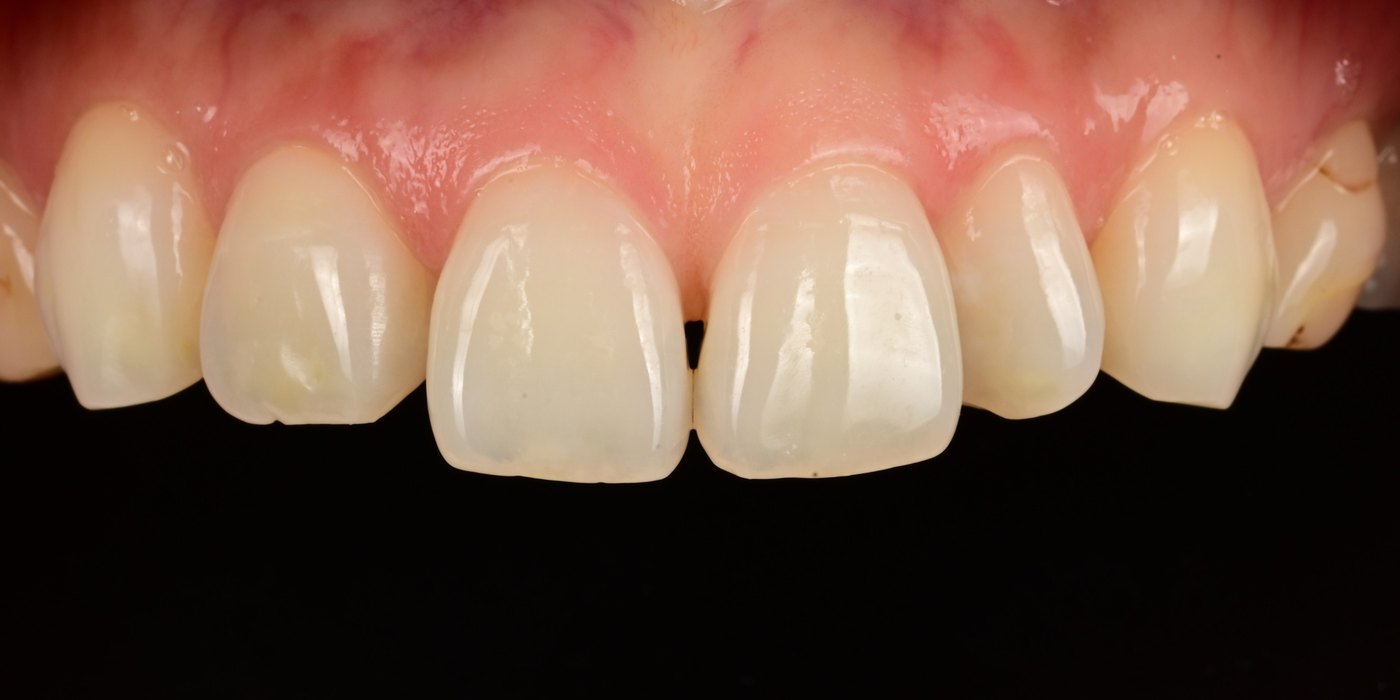
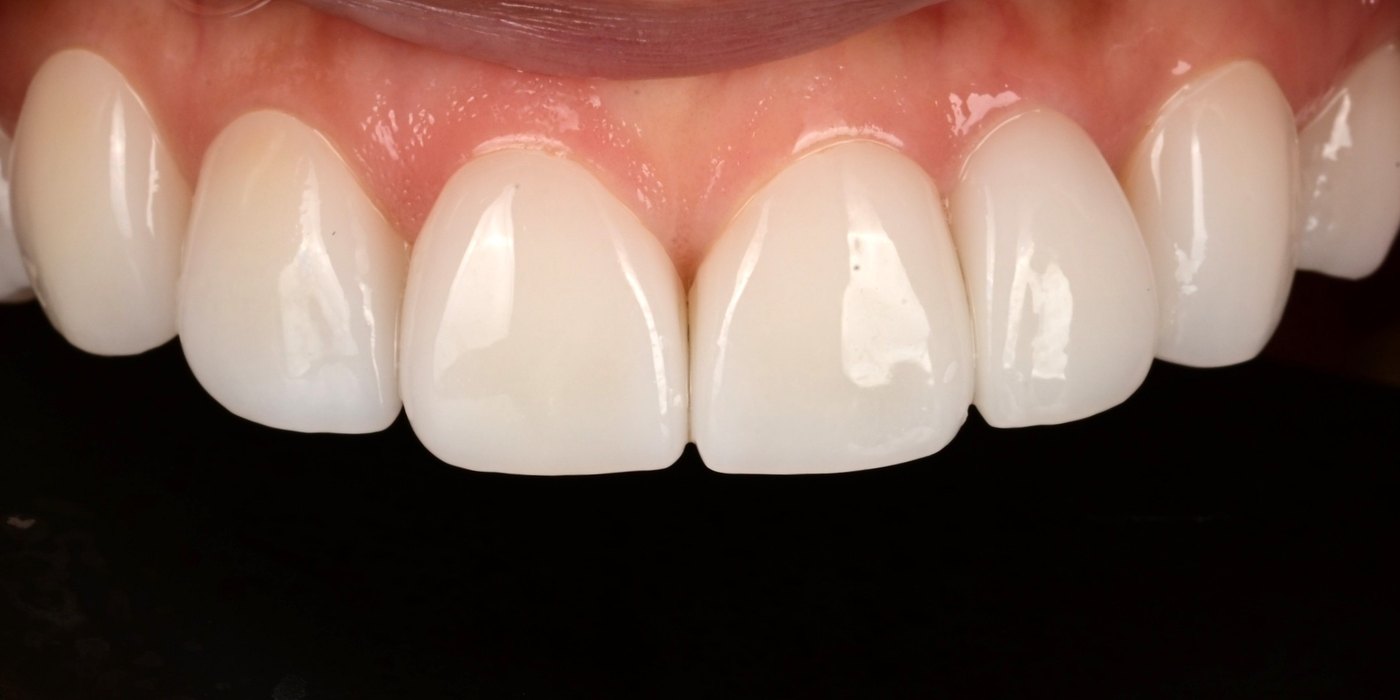
Consistent form and shade across the arch, with the strength to handle a wider range of cases. Individual results vary.
Feldspathic porcelain — the thinnest, most translucent option
Hand-layered feldspathic ceramic can be built extremely thin, which makes it the natural partner for genuine no-prep and ultra-thin minimal-prep cases. Its light transmission closely mimics natural enamel, which is why it's often chosen when the goal is an "invisible" result rather than an obviously restored one.
The trade-offs are real: it's more technique-sensitive — the outcome depends heavily on the ceramist's hand — and it's less fracture-resistant than stronger ceramics. It's also less suited to patients with heavy occlusal forces or grinding habits.
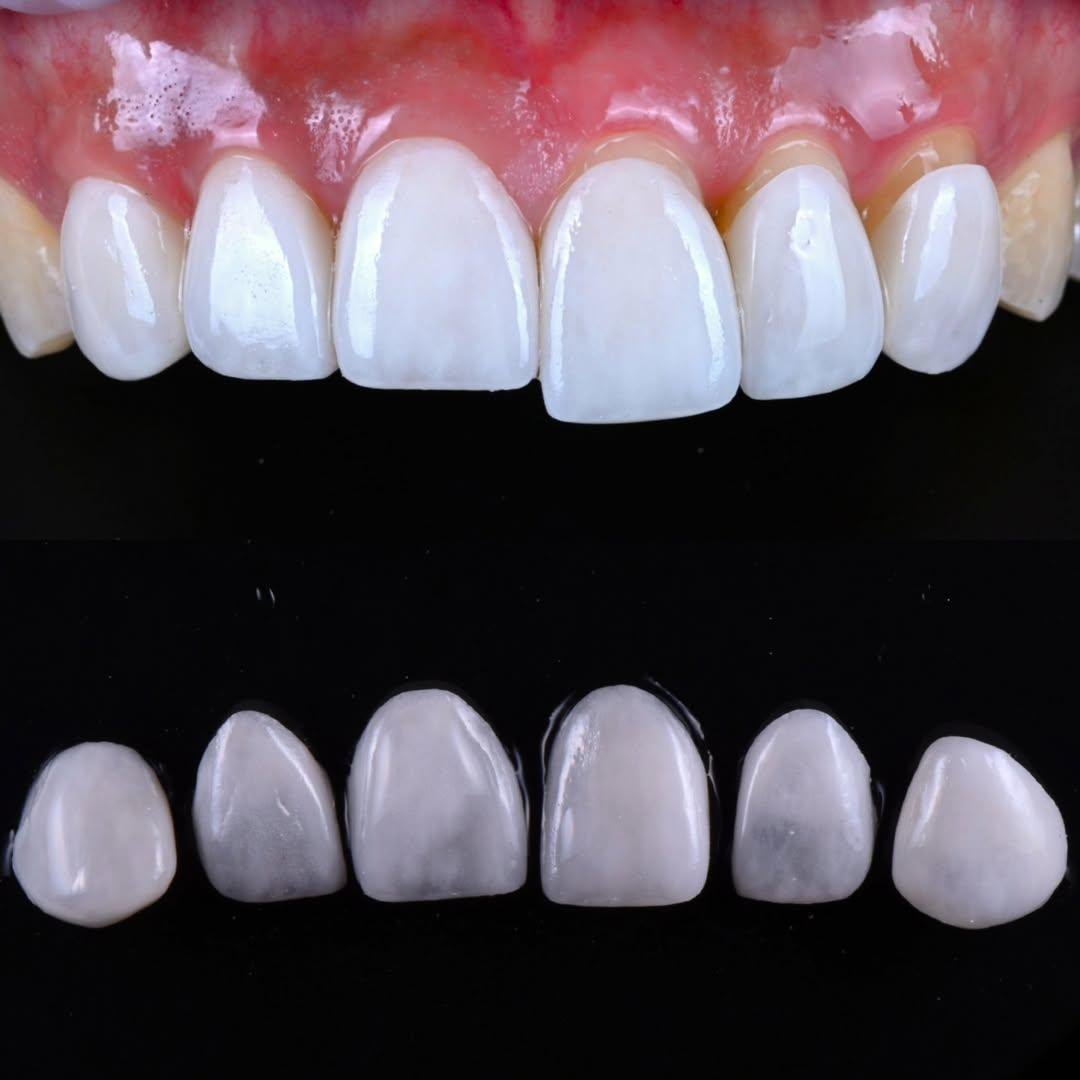
What the layering actually buys is internal structure. Natural teeth aren't one flat colour — they're more opaque near the gum, more translucent at the biting edge, with faint vertical striations and subtle surface texture that catches light unevenly. A ceramist building in layers can reproduce those gradients, and can make each tooth slightly different from its neighbour. That last part matters more than most people expect: a smile reads as natural largely because the teeth are not identical to each other.
Case · Feldspathic porcelain (hand-layered)
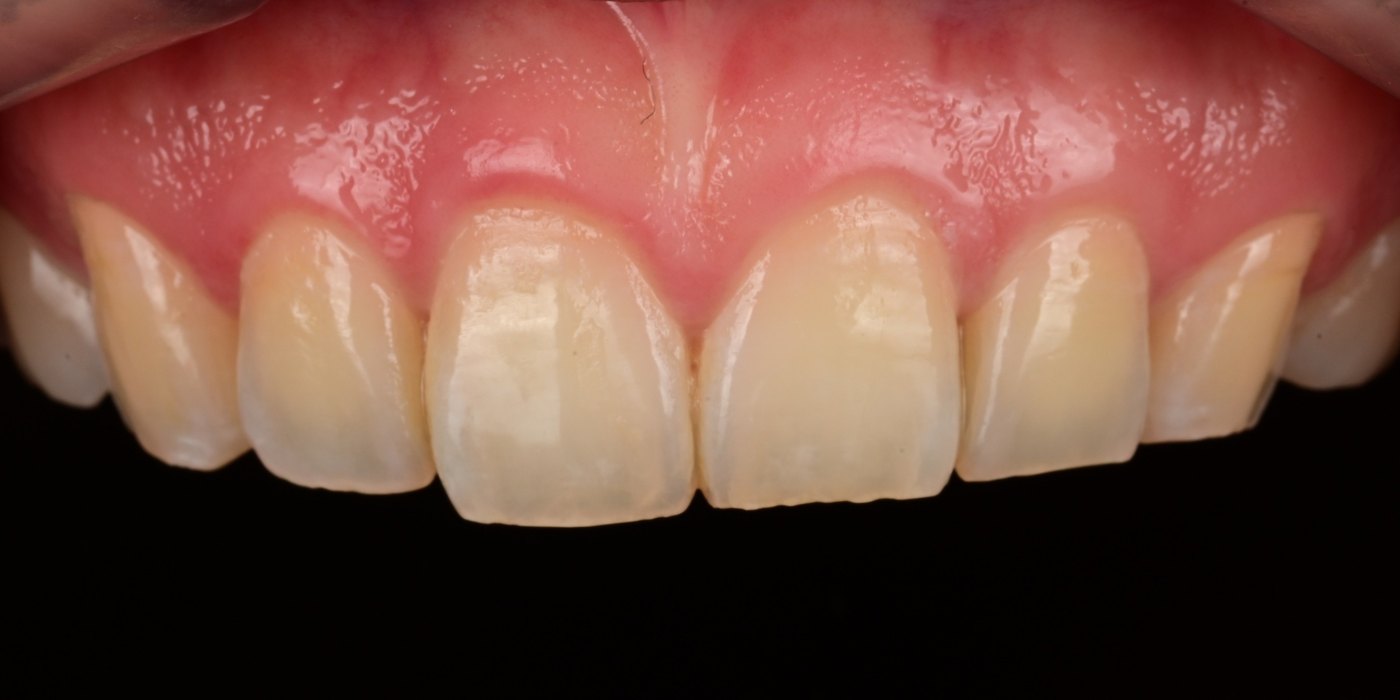
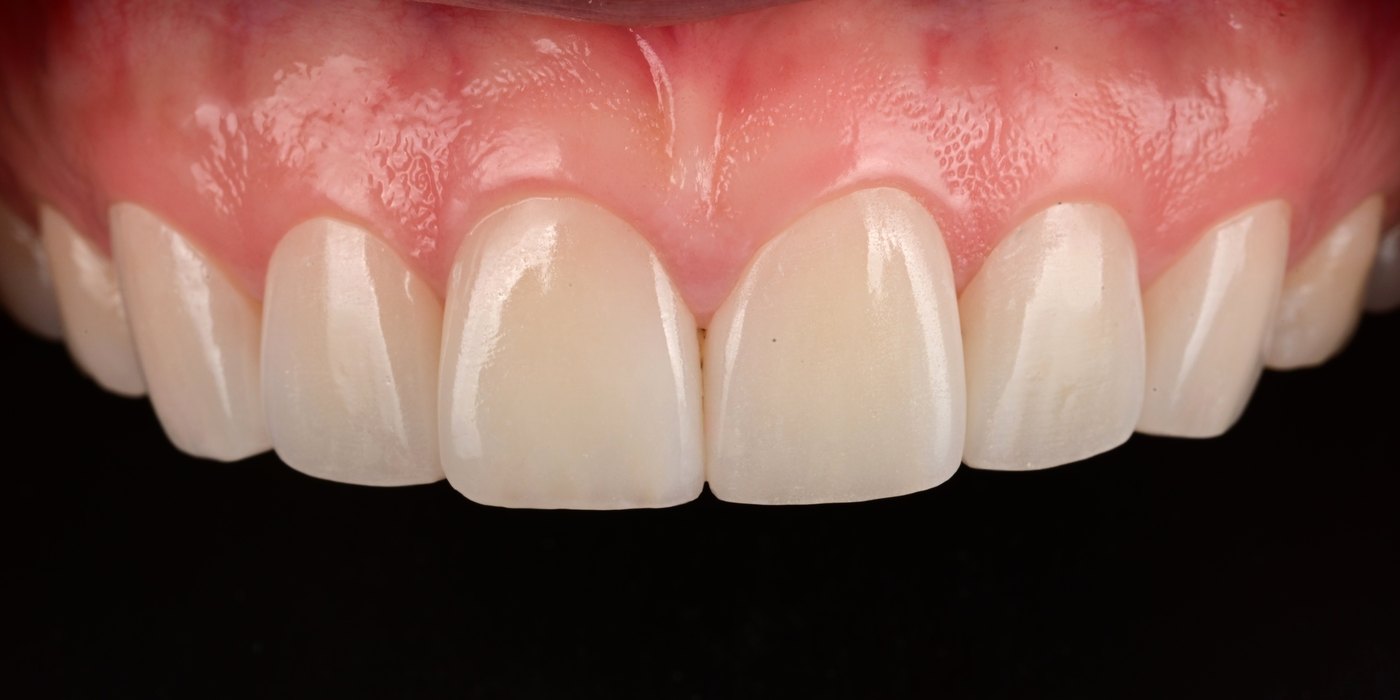
Note the gradient from the gum line to the incisal edge, and the slight differences between adjacent teeth — the detail hand layering allows. Individual results vary.
A separate point worth knowing: zirconia is sometimes proposed for veneers, usually when the underlying tooth is dark and needs masking, or when extra fracture resistance is wanted. It's strong, but it requires a different bonding protocol, and the same review concluded that long-term veneer-specific evidence for zirconia remains more limited than for the established glass ceramics.[8]
Why Fabrication Method Matters
The material and technique used to make the veneer affects both appearance and longevity, largely independent of how much tooth was prepared:
- Hand-layered feldspathic ceramic — built up by hand in thin layers; can achieve the most natural light transmission and the thinnest overall result, but is more technique-sensitive and depends heavily on the ceramist's skill
- Pressed ceramic — more dimensionally consistent, slightly less translucent than hand-layered feldspathic
- Milled ceramic — highly consistent and efficient to produce, though early milling systems traded some translucency for that consistency
A meta-analysis of feldspathic and glass-ceramic laminate veneers found survival and complication rates that varied meaningfully by material and fabrication method — reinforcing that "veneer" is a category, not a single standardized product.[2]
What the Long-Term Survival Data Shows
Between materials, survival is comparable
A 2025 systematic review and meta-analysis of 29 studies found no statistically significant difference in survival between the main ceramic materials, at a mean follow-up of 10.4 years:[8]
- Lithium disilicate (e.max) — 96.81% pooled survival
- Feldspathic porcelain — 96.13% pooled survival
- Leucite-reinforced glass ceramic — 93.70% pooled survival
Feldspathic and lithium disilicate performed equivalently (p = 0.667). The review did note that lithium disilicate came out slightly ahead on long-term technical and biological complication rates — fewer chips, cracks and debonds over time — even though overall survival was comparable.[8]
Preserving enamel matters more than the material choice
Veneers bond most reliably to enamel; when preparation exposes dentin underneath, bond strength and long-term outcomes tend to be less favorable.[4] This is why how much tooth is removed tends to matter more for longevity than which ceramic is used.
The evidence on minimal- and no-prep veneers specifically is stronger than many patients expect:
- A study following patients for a mean of 9 years found survival rates for no-prep or minimally invasive veneers equal to or better than conventionally prepared veneers.[1]
- A separate study following 170 feldspathic veneers over 7 years reported an overall survival rate of 91.77%, comparing vertical-preparation and no-prep groups directly.[5]
- A prospective cohort study of 60 ultrathin ceramic veneers bonded to nonprepared teeth reported a 100% clinical success rate over a one-year follow-up.[6]
- A broader systematic review found that minimal-prep veneers' higher bond strength to enamel — compared with prepared veneers, which sometimes bond partly to dentin — is a likely explanation for their favorable long-term performance.[7]
None of this means no-prep is "better" in general — it means that when the case is appropriate, preserving enamel is associated with strong durability, not a compromise made purely for comfort or marketing.
Questions Worth Asking Before You Book
If you're evaluating a clinic for veneers while researching options in Korea, these questions are more informative than any technique's brand name:
- How did you decide between no-prep and minimal-prep for my case — what specifically about my tooth dimensions, tooth and lip position, smile line, and occlusion led to that decision?
- Which material are you recommending — and why that one for my case specifically?
- What fabrication method will be used, and how much preparation does it require?
- What survival data supports this approach for a case like mine?
- If my teeth are already a normal size, would you still recommend no-prep — and if so, why?
A clinic that answers these in specific, case-by-case terms is generally a stronger sign than one that presents a single technique as its signature offering for every patient.
Summary
"Korean veneers" is a search term, not a clinical standard. No-prep, minimal-prep, and traditional preparation are different tools suited to different starting points — mainly determined by how your current tooth size compares to the ideal. When the fit is right, the long-term evidence for enamel-preserving approaches is genuinely strong.[1][5][6]
The single most useful question to bring into a consultation isn't "do you do Korean veneers" — it's "based on my tooth size, which approach fits, and what's the evidence for it?" A specific, diagnostic answer is a better predictor of your outcome than any technique's name.
References
- Smielak B, Armata O, Bojar W. A prospective comparative analysis of the survival rates of conventional vs no-prep/minimally invasive veneers over a mean period of 9 years. Clin Oral Investig. 2022;26:1-11.
- Morimoto S, Albanesi RB, Sesma N, et al. Main clinical outcomes of feldspathic porcelain and glass-ceramic laminate veneers: a systematic review and meta-analysis of survival and complication rates. Int J Prosthodont. 2016;29(1):38-49.
- Bolton WA. Disharmony in tooth size and its relation to the analysis and treatment of malocclusion. Angle Orthod. 1958;28(3):113-130.
- Clinical survival and complication rate of ceramic veneers bonded to different substrates: a systematic review and meta-analysis. J Prosthet Dent. 2024.
- Mihali SG, Lolos D, Popa G, Tudor A, Bratu DC. Retrospective Long-Term Clinical Outcome of Feldspathic Ceramic Veneers. Materials. 2022;15(6):2150. doi:10.3390/ma15062150.
- Al-Mokdad A, Swed E, Kadhim M, Kanout S, Al-Mokdad A, Abdo A, Hajeer MY. Clinical Success Evaluation of Ultrathin Ceramic Veneers Bonded to Nonprepared Teeth: An Observational Prospective Cohort Study. Cureus. 2024;16(9):e68699. doi:10.7759/cureus.68699.
- Clinical Success Evaluation of Ultrathin Ceramic Veneers Bonded to Nonprepared Teeth (discussion of enamel vs. dentin bonding strength as a determinant of long-term survival). PMC.
- Klein K, et al. Survival and Complication Rates of Feldspathic, Leucite-Reinforced, Lithium Disilicate and Zirconia Ceramic Laminate Veneers: A Systematic Review and Meta-Analysis. J Esthet Restor Dent. 2025. doi:10.1111/jerd.13351. (29 studies; pooled survival at mean 10.4 years — feldspathic 96.13%, LDS 96.81%, LRGC 93.70%; no significant difference between materials)
This article is for general educational purposes and does not replace an individual diagnosis. The figures cited are averages or ranges reported in the literature; individual outcomes vary with tooth anatomy, material choice, and technique. Treatment decisions should be made after an in-person or photo-based assessment with a qualified dentist.