For international visitors
Teeth Whitening in Seoul —
Cleaning & Whitening for Visitors
What this page covers
One visit, about 90 minutes — examination, professional cleaning, and in-office whitening. Most visitors are finished in a single appointment. This page covers how much change to expect, whether it's safe, how long it lasts, and where it fits in your Seoul itinerary.
Can It Be Done in One Visit?
Yes. A standard appointment runs through three steps:
- Examination — a check for decay, gum inflammation and exposed root surfaces before anything is applied
- Professional cleaning — scaling and polishing to remove plaque, tartar and surface stain
- In-office whitening — with a desensitising gel applied first
The cleaning isn't an add-on. Whitening over untreated decay or inflamed gums is what turns mild sensitivity into real discomfort — and a meaningful share of what looks like yellowing is surface stain that cleaning removes on its own, so the shade you start from is often already lighter.
If you want a greater change, a second session a few days later may be recommended rather than extending a single appointment.
How Much Whiter Will My Teeth Get?
It depends on where you're starting and what's causing the discolouration, so a single number would be misleading. A documented case, measured against the same shade guide at both visits:
In-office whitening · VITA A4 → A1
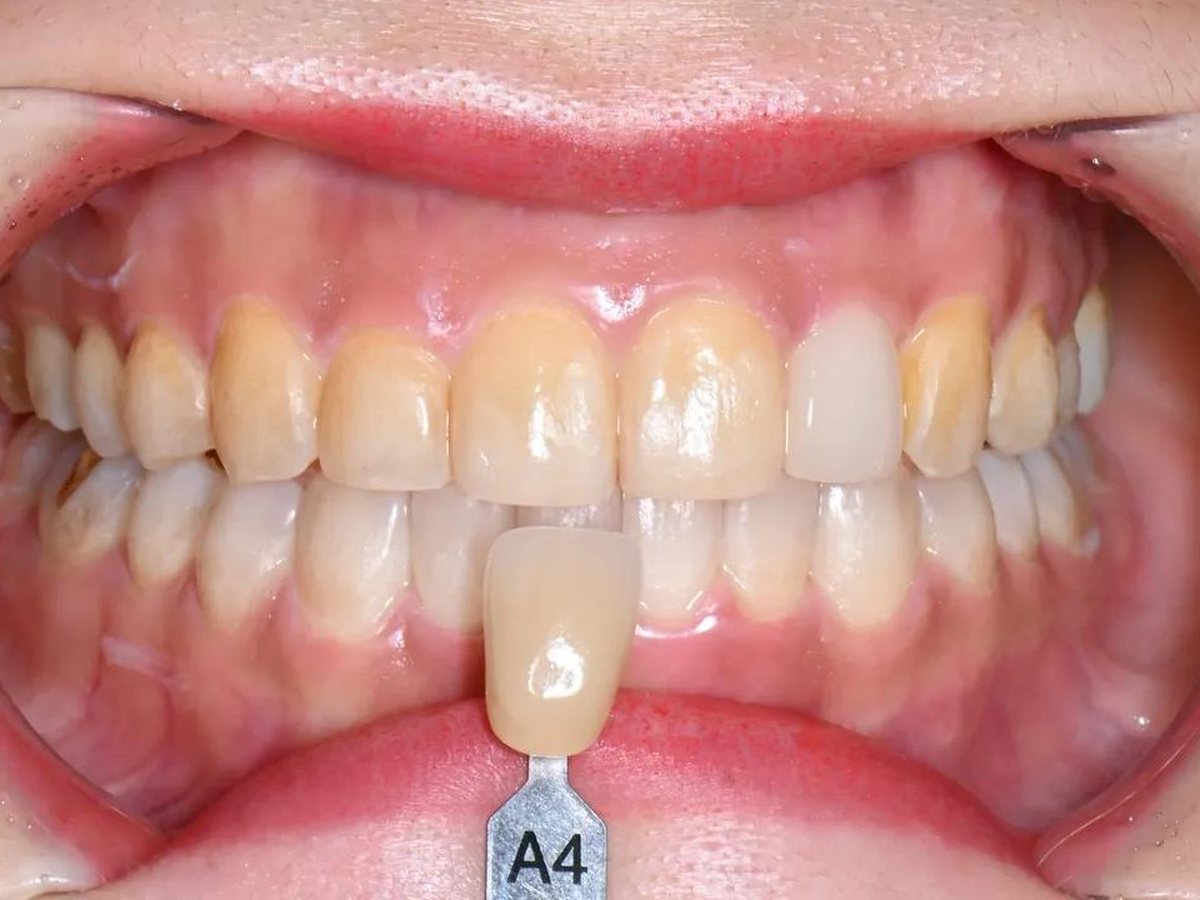
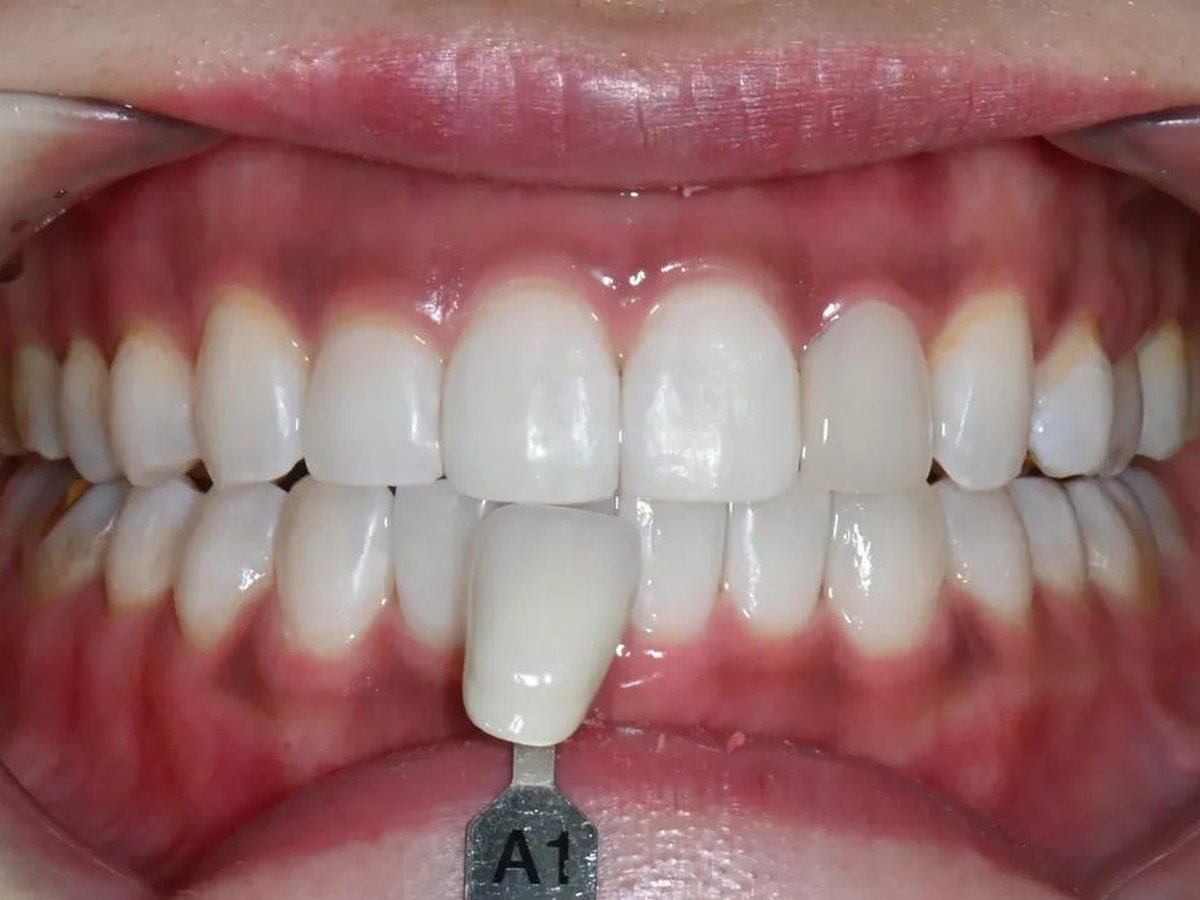
The same shade tab is held against the teeth at both visits, so the change reflects a measurement rather than lighting. Individual results vary.
What responds well, and what doesn't:
- Yellow-toned teeth — generally respond well
- Grey-toned teeth — respond, but less dramatically
- Tetracycline staining — often improves only partially
- Crowns, veneers and fillings — don't whiten at all, so surrounding natural teeth end up lighter than they are
If the last two apply to you, send a photo before booking so you know what to expect.
"My teeth are already fairly white — is it worth it?"
Usually yes. A1 isn't the ceiling. On a shade guide, A1 just means the lighter end of natural tooth colour — shade tabs lighter than A1 exist precisely to describe teeth after whitening.
What changes is the kind of result. Yellow-toned teeth shift noticeably in colour. Already-light teeth have less yellow to remove, so they get brighter rather than dramatically different — less a before-and-after photo, more something people notice in person without being able to name it.
Is It Safe? Will It Hurt?
Most whitening pages say the procedure is painless. That isn't quite true, and it's more useful to be straight about it: sensitivity is the most common side effect. It's temporary, and it can be reduced rather than simply tolerated.
After the session — a fluoride application helps the enamel surface recover.
If you already have sensitive teeth, say so when you book. It changes the plan — usually shorter application times across two sessions.
Does whitening damage enamel?
There's no strong evidence that whitening at appropriate concentrations permanently weakens teeth.
Laboratory studies do show small surface changes, and those results are real. But laboratory studies use extracted teeth in artificial solution, which leaves out saliva — and saliva carries calcium and phosphate, putting minerals back into enamel continuously.
What genuinely matters is not whitening over untreated problems, and not repeating it too often. Which is why the examination comes first.
How Long Does It Last?
Published follow-up studies generally report colour holding for one to two and a half years.[3] Two things are worth knowing about how it gets there.
The first 48 hours. Your teeth look their brightest the moment the session ends — but whitening temporarily dries the enamel, and dry enamel reflects light as brighter than it really is. Over 24 to 48 hours saliva rehydrates it and that extra brightness settles. Two days later it can look as though the whitening "didn't take". It did — you're seeing the temporary part settle, not the result reverse.
After that, a slow drift. The remaining change holds well. An 18-month follow-up found no clinically meaningful colour deterioration. It isn't "lasts a year then reverts" — it's a gradual drift that stays above where it began.
If you want to keep the brighter shade, a short top-up roughly every six months is the practical approach — it doesn't need to repeat the full first session. Between visits, three things slow the drift: avoiding staining foods for the first 48 hours, regular cleanings, and low-concentration at-home products. Worth knowing if you're shopping in Korea: over-the-counter whitening products here are capped at 3% hydrogen peroxide — effective for maintenance rather than for a dramatic change.
When Should I Do It During My Trip?
Which is exactly the problem: those two days of eating are probably part of why you came.
Near the end of your trip — one session, healthy teeth
Often the neatest option. You've already had the food, and the 48-hour staining window falls during your flight and first days home, where what you eat is easier to control. You also arrive home with the result at its brightest.
The trade-off: if any sensitivity turns up, you'll handle it at home rather than coming back in. For most people that settles within a day or two.
Earlier in your trip — if any of these apply
- You want two sessions — three to four days between them works well
- Your teeth are already sensitive — being in Seoul means you can come back if anything needs adjusting
- You haven't had a dental check in a while — better to have time if the examination turns something up
Either way, mention your dates when you get in touch and the appointment can be planned around them. The clinic is in Sinsa-dong, Gangnam-gu — straightforward to reach by subway from most parts of Seoul.
References
- In-office tooth bleaching protocols: an umbrella review of systematic reviews and meta-analyses on whitening efficacy and tooth sensitivity. Saudi Dent J. 2026.
- Zanolla J, et al. Influence of tooth bleaching on the microhardness of tooth enamel: a systematic review and meta-analysis. Aust Dent J. 2017;62(3):276-282.
- Prognosis in home dental bleaching: a systematic review. Clin Oral Investig. 2023.
This page is for general information and does not replace an individual diagnosis. Whether whitening is appropriate, and how much change is achievable, depends on your dental and gum condition and the type of discolouration. Results vary between individuals.